Saturday, 19 December 2015

Life boats are for saving not losing lives!


Lifeboats are designed to save lives, but over the years too many seafarers have lost their lives or been seriously injured during routine safety exercises in davit-suspended boats fitted with on-load release hooks. The ship that cannot sink is yet to be constructed, so vessels need to be fitted with life-saving appliances, for the safety of crew and passengers. In the early days of sailing vessels, such means would be the work boats of the ship or any floating object to hang on to. The risks a seaman faced were well known and in coastal communities it was not an unexpected fate to end one’s life at sea.
Passenger ships represented a particular challenge. The terrible I & B accident in 1912 is the one we remember, but it was not at all the first major one. In the 19th century emigrants on transatlantic passages lost their lives in the thousands. But the loss of over 1,500 lives out of 3500 on board the huge, modern and luxurious vessel “that could not sink” and the shock to realize that the vessel only had lifeboat capacity for half the people on board, put the safety of passengers  and crew on the agenda.
The Convention on Safety of Life at Sea (SOLAS) was adopted in 1914 as the first international regulations on the subject and regulated that there should be means of rescue for everyone on board. Due to the First World War, however, it took some time for these first international regulations to take effect. Further SOLAS revisions of 1929, 1948, 1960 and 1974 plus amendments thereafter have strengthened the regulations for life-saving means, requiring both lifeboats and life rafts on board.
For the safety of lives, the regulators have always considered the lifeboats to be the most important and the life rafts more as a supplement. Among seamen, however, for many years there has been a lack of confidence in lifeboats, which have been seen as rather difficult and dangerous to launch.
Actually, lifeboats did not evolve very fast from the types on board the TITANIC and for a long time remained as open, wooden boats suspended from davits. Glass fiber-reinforced polyester took over as a building material and one out of two boats also got an engine. It was not seen as necessary to have an expensive motor in both the port and starboard boat, as one could tow the other. Covered lifeboats were first required by the SOLAS amendments of 1983 and became mandatory for ships built after 1st July 1986. From then on, shipwrecked seamen leaving a tanker on fire and those to face the North Atlantic in winter or dehydration under a tropical sun stood a better chance to survive. As the vessels grew larger, so did the lifeboats and the distance from the boat deck to the sea level.
Easy to operate gravity davits had long been introduced, but one problem remained from the old days: the difficulty of releasing the lifeboat hooks in a sea swell, and preferably both hooks at the same time. Many seamen have suffered bruises to the head, and broken fingers were not uncommon, in a fight with the heavy blocks. Some release systems were therefore introduced by manufacturers, making it possible to let go of both davit falls simultaneously, by a wire or rod pull from one location of the boat. That made the seaman’s life easier during lifeboat exercises, but in heavy seas the release of both hooks at the same time was still very difficult.

No one knows how many lifeboats have accidentally fallen down, how many lives have been lost and how many people have been injured as a result. This is because many ships may not report all incidents. National authorities of traditional seafaring nations may require their ships to report accidents, but when viewing their annual reports, it is not always clear what happened in a lifeboat accident and whether on-load release gear was involved. In addition to accidents with lifeboats on board ships, it should not be forgotten that there have also been several accidents on board oil rigs, but there are no reliable figures available for them either.
Serious personal injury or death of a seaman will normally end up in the records of a P&I Club. However, even P&I Clubs are not able to provide exact figures, because the Clubs have different systems to register such accidents (for instance, they may be registered under “Lifeboat”, ”Lifesaving appliances”, “Injury”, “Death”, “Fall”, etc.) and Clubs do not report these accidents to any central agency for a total count.
The accidental release of a lifeboat usually happens during exercise or when maintenance work is being carried out. In most cases one hook releases first and the boat may swing like a pendulum. The second hook may release or be torn out of the deck. If there are people on board they will sometimes escape unharmed by just falling into the sea and then being rescued. Although very close to a fatal accident, such near-misses may not be reported at all. It is perhaps natural to try to avoid negative publicity in such cases.
In accordance with SOLAS & LSA Code, every crew member shall participate in at least one abandon ship drill and one fire drill every month. During the abandon ship drill, at least one lifeboat is lowered upto the embarkation deck.
Whilst lowering the life-boat upto the embarkation deck, risk assessment, weather conditions, safety precautions, supervision, due care and diligence should be exercised to prevent any untoward accident/incident occurring.
Further, lifeboats and rescue boat are required to be launched with their assigned crew aboard and maneuvered in the water at least once every three months. On account of the dangers involved, this should only be practiced in sheltered waters under the supervision of an experienced officer.
A more recent development on cargo ships is a free fall lifeboat, in lieu of davit launched lifeboats. On account of the dangers involved in launching such boats, its simulated launching is acceptable.
Lifeboats and rescue boats have been provided to save lives, but if the same lifesaving appliance is going to result in an accident during maintenance and drills, then this is not acceptable. Hence, greater care needs to be taken to prevent such accidents whilst undertaking maintenance and practicing drills.


Friday, 11 December 2015

MAIB 2014 Report: No Crew Deaths on UK Vessels
-An excellent achievement.

The Marine Accident Investigation Branch (MAIB) U.K. established in 1989 following the Herald of Free Enterprise disaster, is an independent unit within the Department for Transport in U.K. The MAIB investigates marine accidents involving UK vessels worldwide and all vessels in UK territorial waters. Their job is to help prevent further avoidable accidents from occurring and not to establish blame or liability.
Empowered by the Merchant Shipping Act 1995, it is a government agency headed by the Chief Inspector of Marine Accidents. The MAIB is the marine equivalent of the much older Air Accidents Investigation Branch and the more recent Rail Accident Investigation Branch, all of them report directly to the Secretary of State for Transport.
Investigations are thorough but are strictly limited to establishing cause, promoting awareness of risks and preventing recurrence. Reporting of accidents to the MAIB is mandatory for all commercially operated vessels in UK waters and for all UK registered vessels worldwide. The MAIB receives between 1000 and 2000 incident reports annually of which 30 to 50 become full investigations with published reports. The choice of which accidents are investigated is made on the basis of the scope of the safety lessons which may be learned as a result of the investigation. The reports do not apportion blame and do not establish liability.
In 2014 the Marine Accident Investigation Branch received 1270 reports of accidents of all types and severity which led to 31 separate investigations being launched.
Recently, MAIB has published their annual report for 2014. The highlights of the report are given below:
             For the fifth year in succession no UK merchant vessel of > 100gt was lost;
             The overall accident rate for UK merchant vessels > 100gt was unchanged from 2013 at 88                  per 1000 vessels;
             There were no crew deaths on UK merchant vessels >100gt in 2014 and a review of                              available records from the last 50 years shows that this has never happened before;
             The average number of deaths over the last 10 years is 4 per year

Several maritime countries, including India, have a marine accident investigation branch                 either as an independent unit or within their maritime administration and carry out marine accident investigations in a similar way.
Major IMO Conventions (SOLAS, MARPOL, LOAD LINES,  STCW, etc.), ISM Code/Safety  Management System, National and Classification requirements aim towards minimizing loss of life, personal injury, loss and damage to property (ship and cargo), accidents, pollution incidents and hazardous occurrences, and thereby build-up a good safety culture throughout the world fleet. The shipping industry is continually striving for achieving zero accidents and in spite of good efforts, this may not be possible as something, sometimes does go wrong.
Hence, the MAIB (UK) 2014 report stating that there were no crew deaths on UK merchant vessels > 100gt, and that this has never happened before for the last 50 years, is indeed laudable. Further, that for the fifth year in succession no UK merchant vessels of > 100gt were lost, is also a very good record.
The afore-said highlights of the MAIB (UK) 2014 report is good encouragement for the rest of the world’s shipping industry to strive even harder towards the goal of zero accidents.


Herald of Free Enterprise


Friday, 4 December 2015


 IMO’s International Maritime Prize 2014 – awarded to Nippon Foundation’s Mr. Sasakawa.
The International Maritime Prize is awarded annually by the IMO Council to the individual or organization judged to have made the most significant contribution to the work and objectives of IMO.
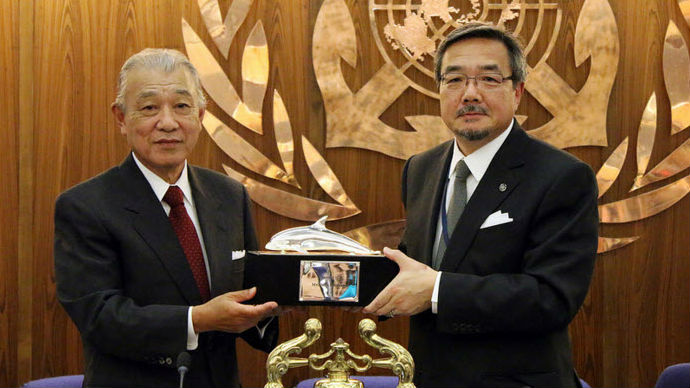
The International Maritime prize consists of a sculpture in the form of a dolphin and also includes a financial award. In addition the awardee is invited to publish a scientific paper on a topic related to the work of the IMO which is published in the organization’s quarterly magazine.
The International Maritime Prize for 2014 was presented to Mr. Yohei Sasakawa, Chairman, The Nippon Foundation, during a ceremony held at IMO on the 23rd of November, 2015.
IMO Secretary – General highlighted Mr. Sasakawa’s long standing dedication to maritime education and training through the initiatives of the Nippon Foundation and its unstinting support to the World Maritime University (WMU), based in Malmo, Sweden and the International Maritime Law Institute (IMLI) in Malta.
Mr. Sasakawa was born in Tokyo, Japan, and joined the Nippon Foundation as a trustee in 1981. He served as President from 1989 and became Chairman on 1st July 2005. The Nippon Foundation is a private, non-profit foundation whose mission, through social innovation, is to achieve a society where all people support one another. Its overall objectives include assistance for humanitarian activities, both in Japan and overseas, and global maritime development.
Mr. Sasakawa’s leadership of Nippon Foundation’s effort to improve the quality of maritime experts around the world by supporting WMU is tremendous. Since 1987, the “WMU Sasakawa Fellowship”, sponsored by the Nippon Foundation, has offered fellowships to students for the two year Master’s degree program.
Mr. Sasakawa has also worked with other international institutions, including IMLI, the UN Division of Oceans and the International Tribunal for the Law of the Sea. Today, there is a network of over 1000 Sasakawa/Nippon Foundation Fellows from more than 131 countries, including India.
Further contributions have been made in the field of maritime safety, security and marine environment protection. To name a few:
  •   Supporting the establishment of the co-operative mechanism in the straits of Malacca and Singapore,
  •  Funding to establish the Memorandum of Understanding on Port State Control in the Asia- Pacific Region (Tokyo MOU);
  • Support for coastguard activities and training in the Asian region;
  • Support for research and technological development projects on maritime safety and marine environment protection, including emissions from ships, Northern Sea route; etc.

A number of WMU graduates from India have benefited from the Nippon Foundation fellowships offered to them, as this made it possible to provide the financial support for pursuing their studies at WMU.
We now extend our heartiest congratulations to Mr. Sasakawa for receiving the IMO International Maritime Prize for 2014. We are grateful to Nippon Foundation and Mr. Sasakawa for their yeoman’s service to the maritime sector and in particular for providing fellowships to a number of Indian students at WMU.


Friday, 27 November 2015

Benefits of World Maritime Day…
The United Nations (UN), via the International Maritime Organization (IMO), created World Maritime Day (WMD) to celebrate the international maritime industry’s contribution towards the world’s economy, especially in shipping.
The event’s date varies by year and country but is generally in the last week of September. For example in 2015, it was celebrated on Thursday the 24th of September, and next year (2016) it will be celebrated on Thursday, 22nd September.
World Maritime Day focuses attention on the importance of shipping safety, maritime security and the marine environment and to emphasize a particular aspect of IMO's work.  The day also features a special message from the IMO’s secretary-general, which is backed up by a discussion paper on the selected subject in more detail. The theme for 2015 was "Maritime education and training", focusing attention on the importance of adequate education and training to ensure a safe, secure and sustainable shipping industry.
World Maritime Day is celebrated in many countries worldwide, including India. Special events and activities are held to celebrate the day, including a symposium/seminar on the theme of the event as conveyed by IMO.
Since 2005, in addition to the official IMO celebrations held at IMO Headquarters in London, there has been a parallel event hosted by a Member State. This year’s parallel event was held in Japan on the 20th and 21st July 2015.
The WMD theme for this year was “Maritime Education and Training”. The Theme was adopted to focus attention on the wider spectrum of maritime education and training, in particular its adequacy and quality, as the bedrock of a safe and secure shipping industry, which needs to preserve the quality, practical skills and competence of qualified human resources, in order to ensure its sustainability.
The 1978 STCW Convention and Code, as amended (STCW 2010), set the international benchmark for the training and education of seafarers. While compliance with its standards is essential for serving on board ships, the skills and competence of seafarers, and indeed the human element ashore can only be adequately underpinned, updated and maintained through effective maritime education and training.
The IMO symposium held on the 24th of September on the topic: Shipping’s future needs people: Is global maritime education and training on course?” The IMO symposium provided an opportunity for a discussion on the future of maritime education and training.
All speakers at the symposium stressed the need to raise the profile and the image of shipping in general, in order to attract young people into the maritime professions. Other speakers brought in the paucity of training berths and some speakers raised the important issue of ongoing quality assessment of seafarer training courses as required by STCW 2010.
This year the parallel event was held in Japan on the 20th and 21st of July, 2015. Maritime education and training needs- now and in the future – were the focus of a high-level international symposium. Delegates also visited maritime heritage sites in Yokohama and witnessed seafarer training demonstrations on the sail training ships Kaiwo Maru and the training ship Taisei Maru. This was followed by a special session addressing the future needs of the industry, which aimed to discuss how educational organizations could go about educating and training high quality maritime human resources, which are necessary for quality shipping and how they could attract the interest of future generations towards the seas and the oceans.
IMO has recently decided on the theme for World Maritime Day 2016, namely, “Shipping indispensable to the world”. Next year the Parallel Event will be held in Turkey.
“Today, around 90 percent of world trade is carried by the international shipping industry. Without shipping the import and export of goods on the scale necessary to sustain the modern world would not be possible. And seaborne trade continuous to expand, bringing benefits for consumers across the world through competitive freight costs. Yet the fact remains that most of the world’s population is not aware of the vital role shipping plays in their everyday lives”, said IMO Secretary General.
There are more than 50,000 merchant ships trading internationally, transporting every kind of cargo. The world fleet is registered in over 150 nations and manned by more than a million seafarers of virtually every nationality.

In India, we benefit from the symposium/seminar, the theme and message from IMO which keeps us abreast of international developments.

Friday, 20 November 2015

Liquefaction – A major hazard on BULK CARRIERS

Liquefaction is a chemical process that turns a previously safe commodity into a cargo with a dangerously high moisture content that can destabilize a vessel. Liquefaction means that a cargo becomes fluid (liquefies). On ships, this happens when the cargo is compacted by the ship’s motion. Cargoes which are prone to liquefaction contain a certain quantity of moisture and small particles, although they may look relatively dry and granular when loaded. Liquefaction can lead to cargo shift and even to capsize and total loss of the ship.
Certain cargoes, particularly nickel ore and iron ore fines, initially look dry and their characteristics are solid during loading on the ship. But during the voyage, concentrate cargoes as afore-mentioned are exposed to agitation under certain conditions including ship’s rolling, wave impact and engine vibration which results in compaction of the cargo.
IMO’s International Maritime Solid Bulk Cargoes (IMSBC) code which is mandatory under the provisions of SOLAS has placed cargoes with a liquefaction hazard in Group ‘A’. Liquefaction can result in cargo shift. This phenomenon may be described as follows:
1)  The volume of the spaces between the particles reduces as the cargo is compacted due to the ship’s motion, etc.;
2)  The reduction in space between cargo particles causes an increase in water pressure in the space;
3)  The increase in water pressure reduces the friction between cargo particles, resulting in a reduction in the shear strength of the cargo; and
4)  Then the cargo begins to flow as a viscous liquid
Liquefaction does not occur when one of the following conditions is satisfied:
a) The cargo consists of large particles or lumps. Water passes through the spaces between the particles and there is no increase in the water pressure. Cargoes which consist entirely of large particles will not liquefy; and
b) The cargo contains a high percentage of air and low moisture content.  Any increase in water pressure is inhibited. Dry cargoes do not liquefy.
Group ‘A’ cargoes with high moisture content (above TML) are prone to sliding, particularly if the cargo is shallow and subject to large heel angles. In the resulting viscous fluid state cargo may flow to one side of the ship with a roll but not completely return with a roll the other way. Consequently, the ship may progressively reach a dangerous heel and capsize quite suddenly.
A number of major liquefaction incidents resulting in capsizing and sinking have taken place over the years. Some of them are given below:
-  On the 27th of October, 2010, ‘Jian Fu Star’ laden with nickel ore from Indonesia sank in South China Sea with loss of 12 lives.
-  On the 10th of November, 2010, ‘Nasco Diamond’ laden with nickel ore from Indonesia sank in the Pacific Ocean with a loss of 20 lives.
-   On the 3rd December, 2010, ‘Hong Wei’ laden with nickel ore sank in the south China Sea with a loss of 10 lives.
-   On the 25th of December, 2011, ‘Vinalines Queen’ laden with nickel ore from Sulawesi sank in the Philippine Sea with the loss of 22 lives.
The ‘Asian Forest’ and the ‘Black Rose’ sank in July 2009 (off Mangalore) and September 2009 (Off Paradip) respectively, while carrying a cargo of iron ore fines during the monsoon season. The Directorate General of Shipping investigated the sinking and concluded that the reason was liquefaction as a consequence of excessive moisture in the cargo. Thereafter, as a preventive measure, DG Shipping issued an MS Notice banning the loading of Iron Ore fines during monsoon months on the Indian coast.
More recently, on the 30th of December, 2014, ‘Bulk Jupiter’ laden with bauxite from Malaysia sank off Vietnam with a loss of 18 lives.

The IMSBC Code requires that concentrates or other cargoes which may liquefy shall only be accepted for loading when the actual moisture content of the cargo is less than its Transportable Moisture Limit (TML).  Considering that if Liquefaction takes place whilst the vessel is rolling in rough weather, it would be very difficult to control the vessel; hence, the major precaution that actual moisture content should be less than its TML should never be compromised.

Friday, 6 November 2015

How to cut Paperwork? - IMO study underway…

The development of a number of IMO and other Conventions, Codes, Resolutions and Circulars and more particularly the development of the ISM code, has led to an increasing burden of paperwork for ship’s officers. Further, with the voluntary implementation of an integrated ship management system in many companies together with commercial, trade and industry requirements, the burden of paper work has increased exponentially.
Documentary evidence for most of the requirements, hard copies and originals have become pre-requisites for surveys, inspections and audits which have also increased substantially. In the earlier years a dedicated officer (Purser) was available to assist with the paper work. Later, to reduce manning cost, the Purser was withdrawn and then the Radio Officer shared this burden.
Further, with the advent of GMDSS and satellite communications, the radio officer has also been withdrawn, so now the full burden and that too an increased burden is fully on the ship’s officers.
On account of the foregoing, ship’s officers are spending far too much time on paper work. This is having a negative impact on ship operations and maintenance, increasing work load, fatigue, tension and stress. One would have imagined that with the advent of automation, computerization and technological advancements, life on board would have enhanced self- satisfaction for ship’s officers; but it seems that earlier times were better with less paper work.
The increased paper work load has already reached alarming proportions and time is not far when an incident may happen as the ship’s officer was busy with paper work!
It is heartening to know that an IMO study is underway and that some data has already been collated to consider the possibility of reducing paper work. Further, in order to take a holistic view, it would be necessary to also consider reducing paper work in commercial, trade, industry, company and non-mandatory areas.
We are looking forward to a positive outcome and hope that paperwork reduces substantially for the overall benefit of the shipping industry and in particular for the benefit of ship’s officers.


Friday, 30 October 2015

Make in India- A fine example from the Indian Automobile Industry
The Leading global automobile manufacturers; Suzuki- Maruti, Hyundai, Honda, Toyota, Volkswagen, Ford, General Motors, Nissan etc. have set up production facilities in India and are catering to both the Indian market and the export markets. Cars are now being exported to diverse markets in Africa, South- East Asia and Europe.

Leading Indian manufacturers; Tata Motors, Mahindra & Mahindra etc. are similarly catering to both the Indian market and the export markets.
The Indian automobile industry is thus amongst the top manufacturers in the world catering to the growing Indian and export markets.

Automobile exports (passenger vehicles) from India have grown from 4.5lakhs in 2009/2010 to 6.2lakhs in 2014/2015 an average annual growth rate of about 8% and the trend is continuing.
Transportation of automobiles for the export market is done by Pure Car and Truck Carriers (PCTC’s) of over 5000 cars (CEUs) capacity. This is the most economic and efficient way for sea transportation of automobiles.

Large PCTC’s of various leading international shipping lines, such as, Hoegh Autoliners, NYK, MOL, Wallenius Wilhelmsen, etc. make regular calls at Indian ports to load and transport automobiles by Ro-Ro concept.

It would be observed from the foregoing that the manufacture of automobiles in India by leading international and Indian manufacturers is one of the best examples of the “Make in India”, concept. Taking a lead from here, perhaps it can be replicated in a number of other industries too.

Then, what about the shipbuilding industry, will it be possible? Perhaps yes, at a later date, when we are able to overcome the constraints and numerous problems. The demand for RoRo PCTC’s is likely to increase with the increase in exports and this would provide a good opportunity to Indian shipping lines to consider diversifying and acquiring a few PCTC’s.